Ancient Capital · Ramses II · Open-Air Museum · Visitor Guide · Private Tours
Memphis Egypt | Ancient Capital, Ruins & Visitor Guide
Discover Memphis, the ancient capital of Egypt.
Memphis, Egypt, was one of the most important cities of the ancient world and the capital of Egypt during the Early Dynastic Period and Old Kingdom. Located near modern Mit Rahina, south of Cairo, the ancient city was a major political, religious and cultural centre associated with the god Ptah. Today, visitors can explore surviving monuments at the Memphis Open-Air Museum, including a colossal limestone statue of Ramses II and a remarkable alabaster sphinx. Memphis and its surrounding necropolis have been part of a UNESCO World Heritage Site since 1979.
Long before Cairo became Egypt's capital, another great city
stood near the Nile. Its name was Memphis, and for centuries
it played a central role in the political, religious
and cultural life of ancient Egypt.
Memphis was established around the beginning of Egypt's
dynastic history and became the capital during the
Early Dynastic Period and Old Kingdom.
Its location near the meeting point of the Nile Valley
and Delta made it strategically important. From here,
rulers could oversee major routes connecting Upper
and Lower Egypt.
But Memphis was much more than an administrative centre.
It was a city of temples, royal residences, workshops,
religious ceremonies and skilled craftspeople.
Its influence extended far beyond the surrounding region.
Today, much of the ancient city has disappeared beneath
centuries of sediment, changing landscapes and later
settlements. Yet its surviving monuments still offer
a fascinating connection to one of the world's
earliest great civilisations.
The Origins of an Ancient Capital
The History of Memphis: Egypt's Ancient Capital
The story of Memphis begins at the dawn of ancient Egyptian civilisation.
According to later Egyptian tradition, the city was founded by Menes,
the legendary ruler associated with the unification of Upper and Lower Egypt.
Modern historians treat the details of this tradition with caution,
but the city's importance during the earliest dynasties is well established.
Memphis became a major centre of royal authority and administration.
Its strategic location gave it access to important agricultural regions,
transportation routes and commercial networks.
During the Old Kingdom, when Egypt's earliest great pyramids were constructed,
Memphis played a leading role in the kingdom's political organisation.
The nearby pyramid fields of Saqqara Necropolis, Dahshur and Giza reflect
the extraordinary wealth, religious beliefs and administrative
capabilities of this period.
Although political power shifted to other cities during later periods,
Memphis remained important for centuries.
Its temples, religious traditions and artistic workshops
continued to influence Egyptian civilisation.
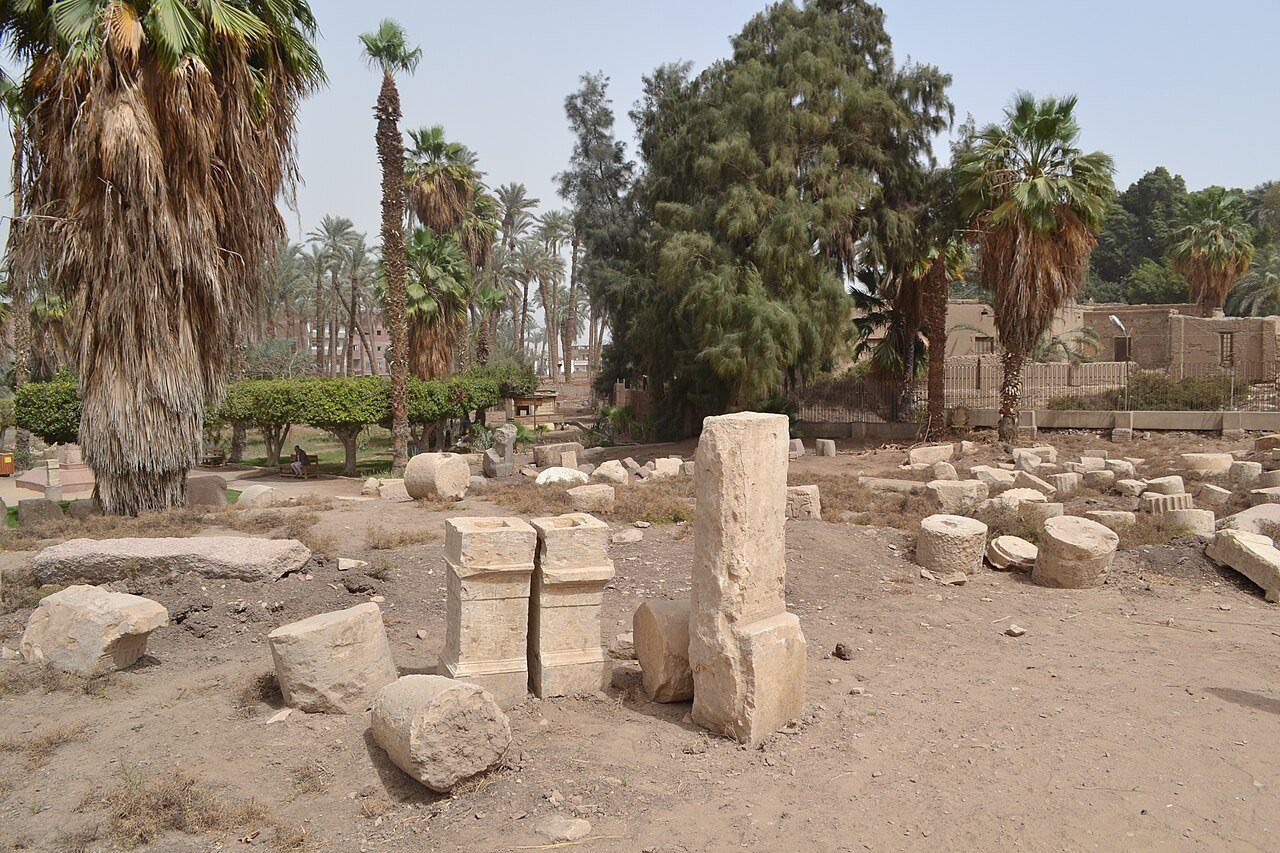
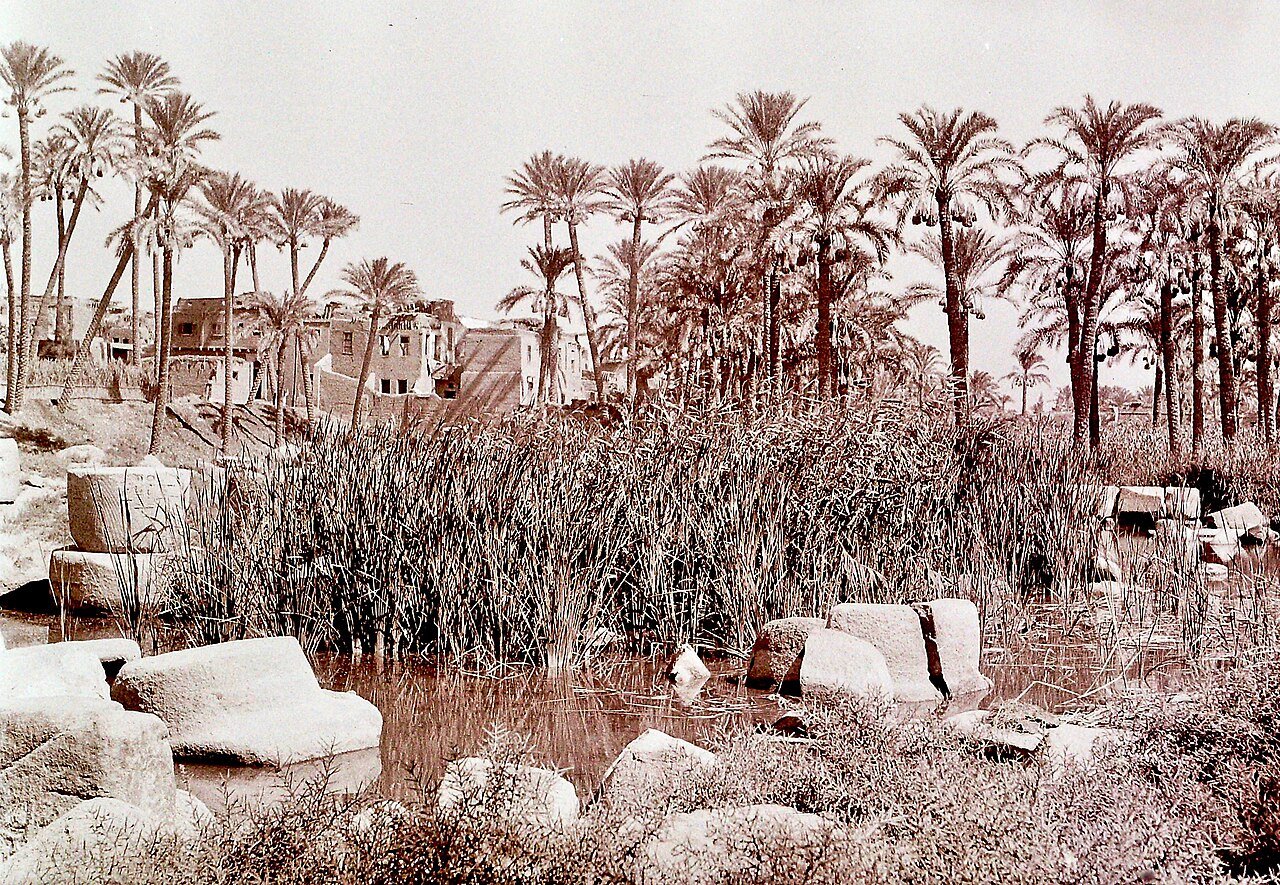
Ancient architectural remains at Memphis.
Photo source
The colossal Ramses II statue in Memphis.
Photo source
Why Memphis matters: The history of Memphis helps explain
the political power and administrative organisation behind the construction
of Egypt's earliest monumental pyramids.
Who Founded Memphis?
Ancient Egyptian tradition credits Menes with founding Memphis
around the beginning of the First Dynasty.
Menes is closely associated with the political unification of Egypt,
although his exact historical identity remains debated.
The founding of Memphis symbolised the importance of controlling
both the Nile Valley and the Delta.
Its location helped establish the city as a major centre
of government and royal power.
Why Was Memphis the Capital of Ancient Egypt?
Memphis occupied a highly strategic position near the entrance
to the Nile Delta.
This allowed the city to connect different parts of Egypt
and oversee important trade and transportation routes.
Its location also placed it close to agricultural resources
and major religious and royal centres.
During the Old Kingdom, Memphis became one of the most
influential cities in the ancient world.
When Did Memphis Stop Being Egypt's Capital?
Memphis did not lose its importance in a single event.
Over time, Egypt's political centres changed as different dynasties
established royal residences and administrative centres elsewhere.
Thebes became particularly important during the New Kingdom,
while Alexandria emerged as a major capital during the Ptolemaic Period.
Nevertheless, Memphis continued to serve important religious
and administrative functions long after its earliest period
of political dominance.
Its eventual decline occurred gradually as Egypt's urban
and political landscape changed.
Ancient Monuments & Archaeology
Memphis Open-Air Museum: What Can You See Today?
Visitors arriving at Memphis today should not expect
to walk through a fully preserved ancient city.
Instead, the main visitor experience centres on the archaeological
remains and monumental sculptures displayed in the
Memphis Open-Air Museum at Mit Rahina.
Although much of the ancient city has been lost,
the surviving artefacts offer a glimpse of the power,
craftsmanship and religious significance of Memphis.
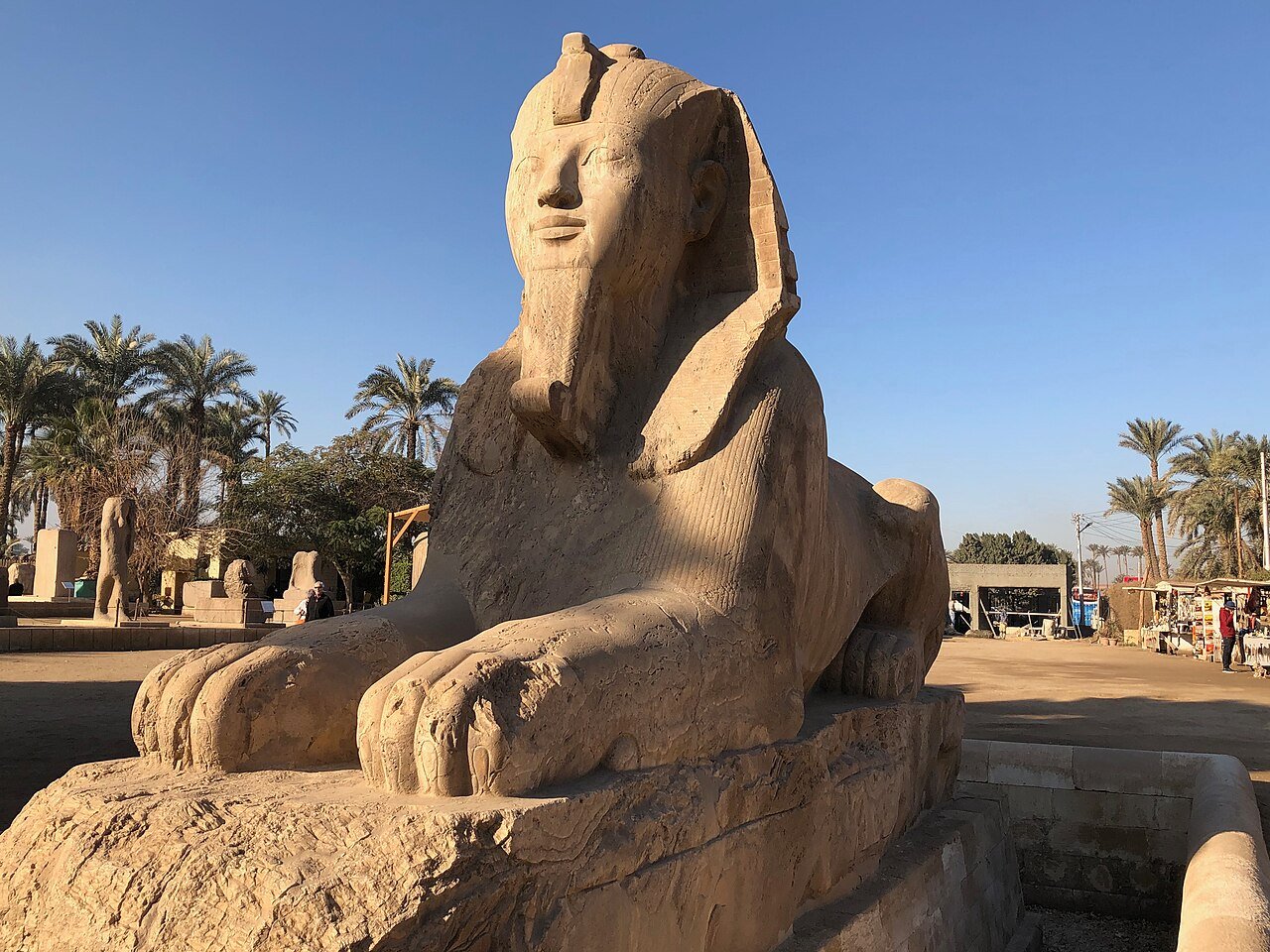
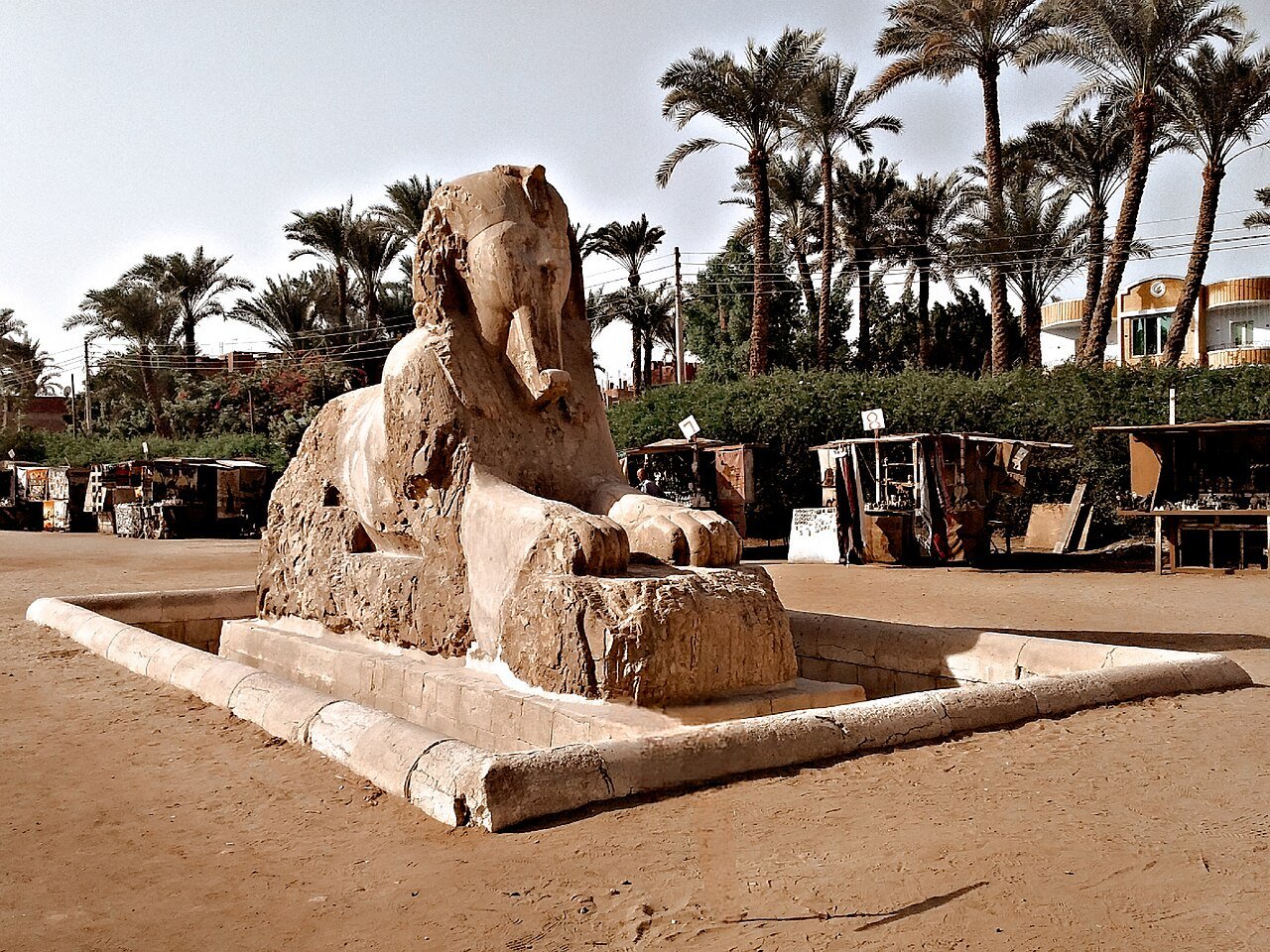
Memphis Open-Air Museum, Mit Rahina.Ancient sphinx sculpture at Memphis.
The Colossal Statue of Ramses II
One of the most impressive monuments at Memphis is the enormous
limestone statue of Pharaoh Ramses II.
Ramses II ruled Egypt during the Nineteenth Dynasty
and is remembered for his extensive building projects
and monumental statues.
The colossal sculpture at Memphis depicts the pharaoh
in an idealised royal form, reflecting the importance
of kingship and divine authority in ancient Egypt.
Today, the reclining statue is displayed in a protective
museum structure where visitors can appreciate its
extraordinary scale and carved details.
The monument is particularly fascinating because its
craftsmanship remains visible despite the damage it
has suffered over thousands of years.
Standing beside this enormous representation of Ramses II
gives visitors a sense of the ambition and artistic skill
of ancient Egyptian sculptors.
Ramses II colossus.
Source
Colossal royal sculpture.
Source
The Alabaster Sphinx of Memphis
Another remarkable monument is the Alabaster Sphinx,
a large stone sculpture featuring the body of a lion
and the head of a human.
In ancient Egypt, sphinxes were closely associated
with royal power, protection and sacred spaces.
The Memphis sphinx is smaller than the Great Sphinx of Giza,
but it remains an impressive example of ancient Egyptian sculpture.
Its exact royal identification is uncertain,
although it is often associated with the New Kingdom.
Visitors can admire its proportions, carved features
and distinctive pale stone.
The museum area also contains additional statues,
architectural fragments and archaeological objects
recovered from ancient Memphis.
These remains help illustrate the artistic and religious
traditions that once flourished in the city.
Many are associated with temples, royal monuments
and the worship of Egyptian deities.
Although the original buildings have largely disappeared,
their surviving fragments offer valuable evidence
of Memphis's former importance.
Religion & Sacred History
The Temple of Ptah and the Religious Importance of Memphis
Memphis was one of ancient Egypt's most important religious centres.
Its principal deity was Ptah, a creator god closely associated
with craftsmanship, architecture and artistic production.
The great Temple of Ptah once stood at the heart
of the city's religious life.
Priests performed rituals, offerings were presented to the gods
and royal monuments reinforced the connection between
kingship and divine authority.
The temple complex was one of the most significant
sacred places in ancient Egypt.
Although little of the original structure survives above ground,
archaeological discoveries continue to reveal evidence
of its former scale and importance.
Colossal statue fragments associated with the Temple of Ptah.
Photo source
Who Was Ptah in Ancient Egyptian Religion?
Ptah was an important Egyptian creator deity
and the patron of craftspeople and artisans.
He was particularly associated with Memphis,
where his cult held a central position
in the city's religious traditions.
In Memphite theology, creation was connected
with divine thought and speech.
The worship of Ptah reflected the city's importance
as a centre of craftsmanship, architecture
and religious authority.
The Connection Between Memphis and the Name Egypt
One fascinating historical connection involves
the name of the country itself.
The ancient Egyptian name Hut-ka-Ptah,
associated with the temple of Ptah at Memphis,
is widely considered an important linguistic
ancestor of the Greek name Aigyptos.
This connection demonstrates how strongly
the religious identity of Memphis influenced
the way Egypt became known beyond its borders.
The Lost Ancient City
What Happened to the Ancient City of Memphis?
Considering its enormous historical importance,
visitors are often surprised by how little
of ancient Memphis remains visible today.
The city's decline was gradual.
Over centuries, political power shifted,
religious traditions changed and the surrounding
landscape evolved.
Many buildings were constructed from mudbrick,
a material far less durable than the massive stone
monuments found in Egypt's royal necropolises.
Flooding, sediment accumulation, the reuse of building materials
and later development also contributed to the loss
of ancient structures.
As a result, much of Memphis survives through archaeological
remains rather than complete buildings.
Yet this does not diminish its historical significance.
In fact, the surviving statues and monuments are reminders
of a city that once helped shape the course
of Egyptian civilisation.
Two Sides of Ancient Egypt
Memphis and Saqqara Necropolis: Understanding the Connection
Memphis and Saqqara Necropolis are closely connected,
but they were not the same place.
Memphis was a major ancient city
and centre of political and religious life.
Saqqara Necropolis was one of the principal
burial grounds associated with the city.
While people lived, worked and worshipped in Memphis,
kings and members of the elite were buried in monumental
tombs and pyramid complexes on the desert plateau.
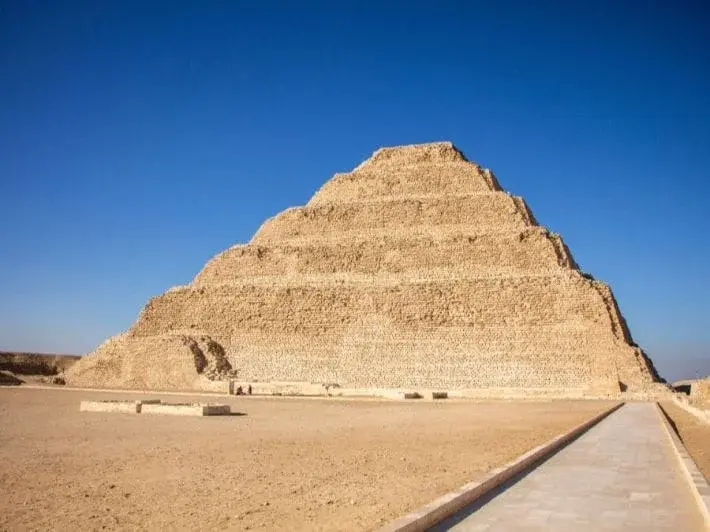
The famous Step Pyramid of Djoser at Saqqara Necropolis
illustrates the development of royal funerary
architecture during the Old Kingdom.
Visiting both locations allows travellers to explore
two different aspects of ancient Egyptian civilisation:
the world of the living and the beliefs surrounding
death and the afterlife.
For anyone interested in understanding the history
of ancient Egypt, combining Memphis and Saqqara Necropolis
is particularly rewarding.
The Step Pyramid of Djoser at Saqqara Necropolis.
Photo source
Photography: Wikimedia Commons and externally hosted reference images.
Image credits and applicable licences should be checked on the linked source pages before commercial publication.
External image URLs may change or become unavailable.
Location & Directions
Where Is Ancient Memphis Located?
Ancient Memphis is located near the modern village
of Mit Rahina, south of Cairo,
on the western side of the Nile Valley.
The archaeological site is closely connected
with the nearby pyramid fields of
Saqqara Necropolis
and Dahshur.
Visitor destination:
Memphis Open-Air Museum, Mit Rahina, Egypt.
Find quick answers to common questions about ancient Memphis,
its historical importance, surviving monuments and visiting
the archaeological site near Cairo.
What is Memphis Egypt famous for?
Memphis was one of the earliest capitals of ancient Egypt and an important religious centre associated with the god Ptah. Today, it is known for the colossal statue of Ramses II and the Alabaster Sphinx at Mit Rahina.
Where is ancient Memphis located?
Ancient Memphis is located near modern Mit Rahina, south of Cairo, close to the archaeological sites of Saqqara Necropolis and Dahshur.
Who founded Memphis in Egypt?
Later ancient Egyptian tradition credits Menes with founding Memphis around 3100 BC, although the historical details of its foundation remain debated.
Is Memphis older than Cairo?
Yes. Memphis was established thousands of years before modern Cairo developed as a major city.
What can you see in Memphis today?
Visitors can see the colossal limestone statue of Ramses II, the Alabaster Sphinx and other ancient sculptures and archaeological remains at the Memphis Open-Air Museum.
How long does it take to visit Memphis?
Approximately 45–90 minutes is a reasonable planning allowance for the main museum area, depending on your interests and the conditions of your visit.
Is Memphis the same as Saqqara Necropolis?
No. Memphis was an ancient capital and religious centre, while Saqqara Necropolis was one of its principal burial grounds. The two sites are closely connected historically, but they served different purposes.
Can you visit Memphis, Saqqara Necropolis and Dahshur in one day?
Yes. The three sites can be combined in a carefully planned day excursion from Cairo. The exact itinerary depends on opening hours, travel conditions and the monuments selected.
Visit the ancient capital of Memphis, discover the Step Pyramid
of Djoser at Saqqara Necropolis and explore the remarkable pyramids of Dahshur.
Staying in Cairo, Giza, Hurghada, Sharm El Sheikh, Marsa Alam
or another Egyptian city or resort? Contact
egyVibes
to discuss private excursion arrangements, available routes
and suitable travel options.
✓Private transportation from Cairo
✓English-speaking Egyptologist guide
✓Memphis, Saqqara Necropolis and Dahshur itinerary
✓Hotel pickup and lunch included in the listed tour